WELDING

WELDING IN MACHINERY AND EQUIPMENT PRODUCTION

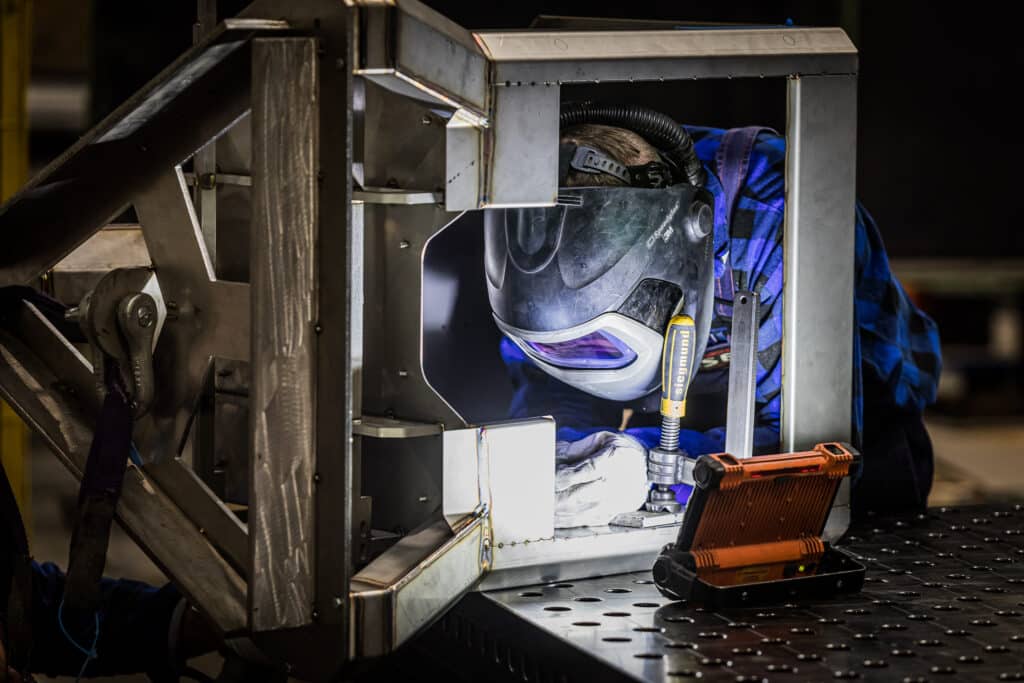
In machinery, equipment and high-quality structures’ production welding plays key role. Our machinery and high-quality welded constructions or structures production offer is strictly associated with welding. Welding is our main process, to which we pay special attention.

Its quality has a direct impact on the durability, safety, and functional performance of the final product. For this reason, the welding process is carried out under strictly controlled conditions and in accordance with clearly defined technological requirements. Depending on the project specification, we select the appropriate welding method, level of automation, and control measures to ensure consistent and repeatable results. This approach allows us to meet demanding industrial standards while maintaining high production efficiency and reliability.

welding stainless steel Poland

welding at base group

ROBOTIC WELDING

welding stainless steel Poland

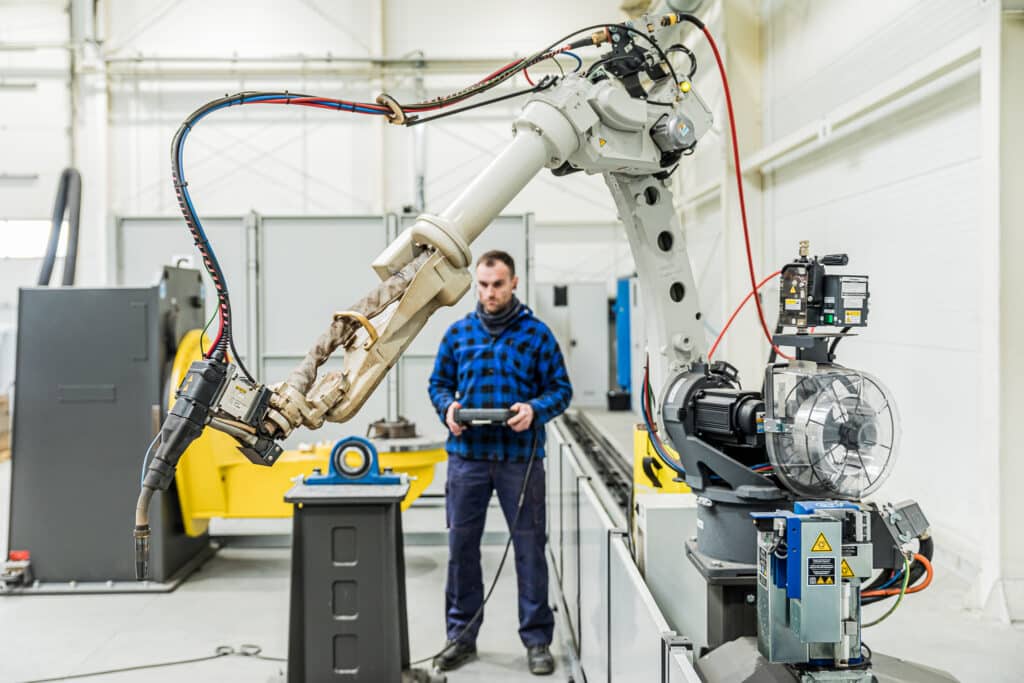
We have three fully automated welding centres. Two of them are designed for the welding of medium to large series of products made of carbon steel.

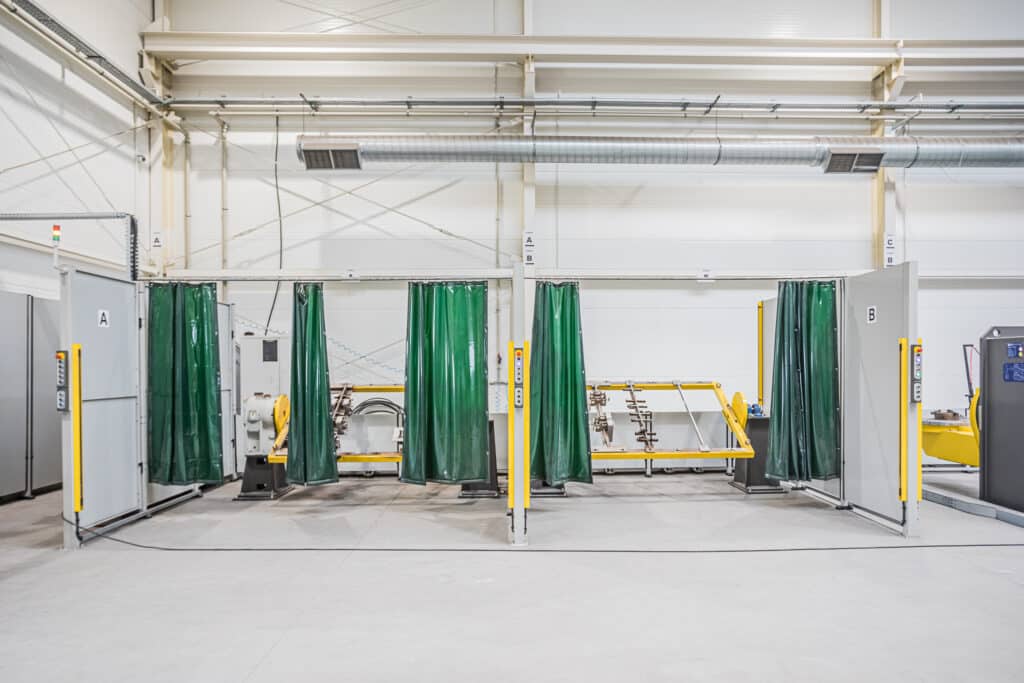
The third, newest workstation has independent working fields where it is possible to simultaneously perform the welding process, prepare/assemble subsequent prefabricated elements and disassemble the finally welded elements from the tooling, without any downtime. It is used for developing welding methods for various grades of stainless steel and aluminum so that the proportion of manual welding performed by employees is reduced to the necessary minimum.

This workstation features the latest generation TM-2000WG3 robot, placed on a track with free working fields and equipped in a 350A integrated power source form PANASONIC.

The robot is placed on a running track with a working stroke of 12m in front of three working fields. The two first ones are equipped with a single-axis positioner with a lifting capacity of 1,000 kg each, to which you can attach devices with workpieces with maximum dimensions of 2,000 x 1,500 mm. The third field is equipped with a double-axis positioner with a lifting capacity of 2,000 kg.

The above process enables the elimination of robot downtime as two processes of welding and disassembly of welded parts as well as assembly of new ones can be conducted simultaneously. A feature that distinguishes welding conducted with the use of the TAWERS robot from other ones available on the market is the integration of the robot controller with the power source. The controller provides full control over the welding process, which results in achieving joints of very high quality. Thanks to the application of a special burner, wire booster and software, the system enables welding aluminum with the use of the ACTIVE WIRE ALUMINUM WELDING METHOD. This method reduces spatters and the appearance of tarnish. PANASONIC positioners are designed to work harmoniously with the robot, enabling positioning and rotating of the part during welding. Combining individual models with one another makes it possible to position almost every complicated workpiece. The robot is equipped with two types of sensors: a touch and an arc sensor.

Spawanie aluminium

This integrated robotic setup allows us to combine process stability with a high level of flexibility in the production of demanding welded components. Precise control of welding parameters, supported by synchronized positioning and sensor-based correction, helps maintain repeatable joint quality even in the case of complex geometries and aluminium parts. For our Customers, this means greater reliability of execution, improved visual quality of the weld, and more efficient production of components requiring consistent technical performance.

Automation and robotization of processes are essential to working in compliance with requirements of Industry 4.0. As a leader in the area of welded industrial structure, Base Group invests in the development of machinery to tailor its product as much as possible to the needs and expectations of its customers.

This approach enables us to increase process stability, improve repeatability, and maintain a high level of production efficiency. At the same time, advanced automation supports consistent quality control and allows us to respond more flexibly to changing project requirements. As a result, we are able to deliver reliable and competitive solutions for demanding industrial applications.

laser WELDING

laser welding (1)

Laser welding is a modern technology used wherever precision, quality, and aesthetics are essential. We offer manual laser welding using MAX PHOTONICS equipment, which enables us to achieve high-quality welded joints, even in hard-to-reach areas.

This technology is ideal for components with thin walls and complex shapes. Minimal distortion after welding and significantly shorter lead times make laser welding an excellent alternative to traditional methods such as TIG or MIG/MAG.

Unlike robotic welding, which is best suited for mass production, manual laser welding offers high flexibility and an individual approach to each project.Thanks to this technology, we are able to meet even the most demanding customer expectations, delivering top-level solutions.

It is particularly effective in projects requiring fast implementation and precise execution of small or complex parts. The concentrated heat input allows for accurate weld placement and supports better control in visually sensitive areas after welding. Manual laser welding is also well suited to prototype work and low-volume production, where adaptability and short response times are especially important, for example when a highly focused laser beam must be used in hard-to-reach areas. This makes it a valuable complement to conventional welding methods within a modern and diversified production environment.

TIG WELDING

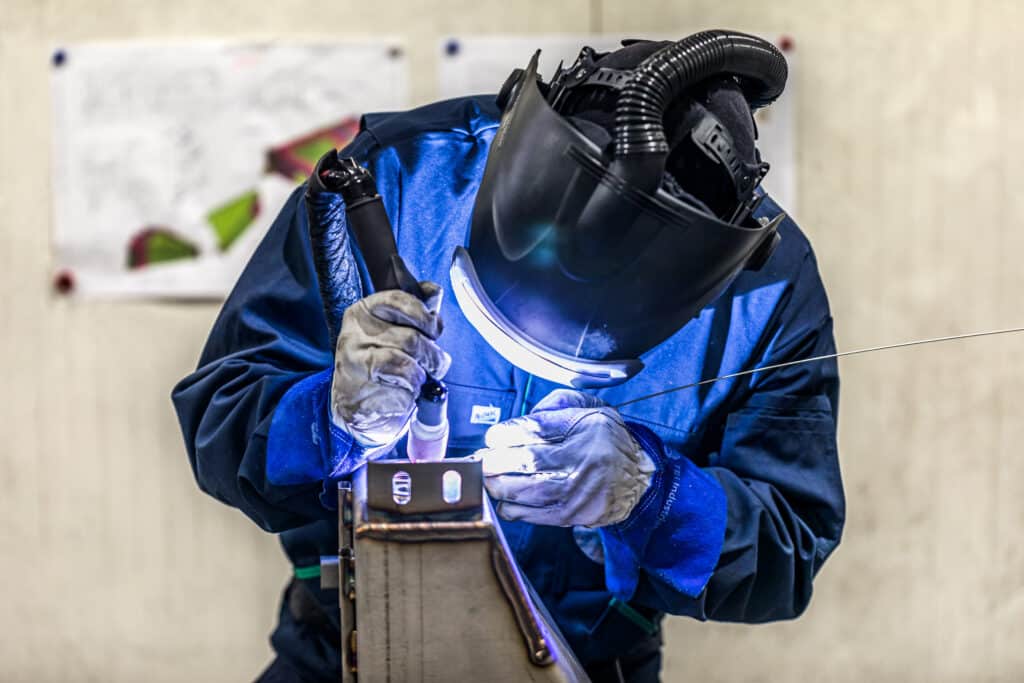
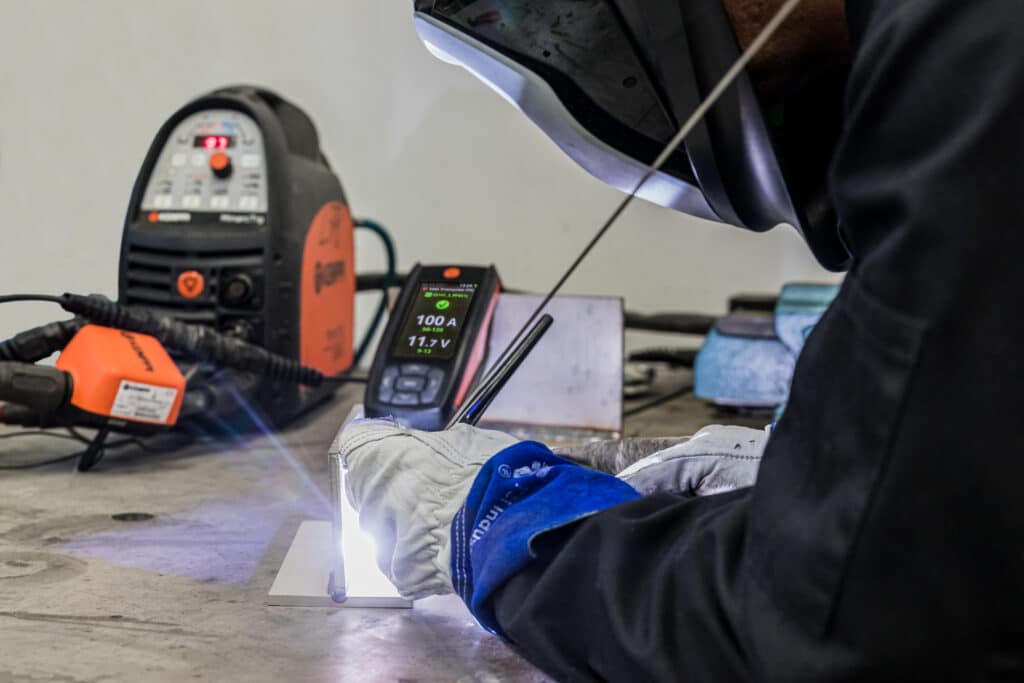
When welding thin sheets for the customers in the marine, food, pharmaceutical or rail industry we apply the TIG welding method to maintain the highest quality. Making stable and clean welds without spatters constitutes an indisputable advantage of TIG welding. 

For TIG welding method we use best in class welding machines. They are equipped with pulse welding which provides us with greater control over the weld pool and, thus, enables us to obtain very precise welds. Thanks to highly qualified welders we can provide the expected quality of the produced machines, equipment and structures. All welders undergo prior testing. Only those whose welding samples meet strict quality requirements are allowed for welding structures delivered to our clients.

This qualification process helps us maintain a consistently high standard of workmanship across all projects. It also reduces the risk of non-conformities and supports the repeatability of critical welding operations. TIG welding is particularly suitable wherever dimensional accuracy, weld cleanliness, and visual quality are of key importance, especially in stainless steel fabrication and welding of thin sections. As a result, we are able to meet demanding technical and quality requirements in the production of advanced industrial components and structures.

welding stainless steel Poland

MAG/MIG WELDING METHOD WITH DOUBLE PULSE

welding stainless steel Poland
Spawanie konstrukcyjne

We have combined requirements regarding the appearance of the weld with high productivity. Our customers frequently the TIG welding method due to high quality of welds’ surface. However, since the TIG welding method is less productive than the MAG/MIG welding method, we wondered whether there was a welding method that would enable us to obtain an aesthetic appearance of welds while providing greater efficiency than the TIG welding method? The MAG/MIG welding method with a double pulse turned out to be the solution! We use MAG/MIG welding method with a double pulse to obtain aesthetically pleasing welds (as in the TIG welding method) and higher efficiency (compared to the TIG welding method).

By using the MAG/MIG welding method with a double pulse we can obtain surface that looks very good (fish scale effect). In addition, the application of automatic wire feeding affects welding efficiency. Structures welded with the use of the MAG/MIG welding method are made faster which results in lower production costs. The MAG/MIG welding method with a double pulse makes it possible to regulate current pulsation and adjust the speed of wire feeding. This way, we improve quality of welds’ surface. While welding using MAG/MIG welding method with a double pulse, current pulses occur in two ranges. The sequential system of our welders automatically combines two levels of pulses: hot l1 and cold l2.

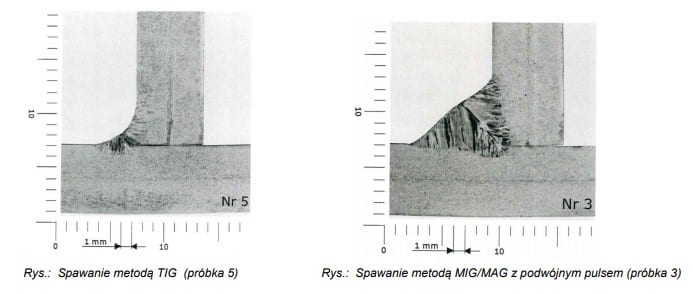
We prepared welding samples using the TIG and MAG/MIG welding method, and subjected them to macroscopic examination. In the first photograph you can see a weld made with the use of the TIG welding method, while the second photograph presents a weld made using the MAG/MIG welding method with a double pulse.

Benefits of the MAG/MIG welding method with a double pulse:

COLD METAL TRANSFER WELDING

We also use the Cold Metal Transfer (CMT) welding method. CMT is characterised by its very low heat input and an exceptionally stable welding arc. In this method, the short circuit is controlled and the current is maintained at a low level. CMT’s advantages include the possibility of avoiding distortion when welding thin material.

Thanks to these characteristics, CMT is particularly well suited for projects requiring high precision, limited thermal impact, and very good visual quality of the weld. The process also helps reduce spatter and supports better control of the welded joint, which is especially important in the production of thin-walled or more demanding components made of stainless or aluminium. As a result, CMT allows us to deliver reliable welding quality while maintaining the dimensional stability of the finished part after welding. This makes it an effective solution for Customers who expect both technical performance and a high standard of workmanship.

WELDING WITH WELDEYE MONITORING SYSTEM

Since welding is our primary process, we take special care to ensure its quality and introduce improvements. We were the first company in Poland to introduce welding with the WeldEye monitoring system. The system helps to control the welding process and ensure the optimum quality of any machinery, equipment and welded metal structures produced.

Thanks to digital supervision, we are able to monitor key welding parameters on an ongoing basis and respond quickly whenever any deviations occur. This gives our Customers greater confidence that the process is carried out in accordance with the applicable requirements and approved welding documentation. WeldEye also supports the traceability of welding operations and helps us maintain clear, well-structured project records. As a result, we can offer not only high welding quality, but also greater process transparency and repeatability throughout production.

Welding in machinery and equipment production System WeldEye

Welding quality verification

To ensure the required quality level of welded joints, the welding process is supported by appropriate verification and control activities. Depending on project requirements, this may include visual inspection, dimensional checks, non-destructive testing, and additional examinations confirming compliance with technical documentation and applicable standards used in welding. Such an approach allows us to detect potential inconsistencies at an early stage and maintain a high level of process reliability after completion of the weld. For our Customers, this means greater confidence in the durability, safety, and repeatability of the finished product.

Selection of the right welding technology

Each project requires an individual approach, which is why the selection of the welding method is always based on the type of material, joint design, quality expectations, and the intended application of the finished structure. By combining manual welding, robotic welding, laser welding, and advanced process variants such as CMT or double pulse MAG/MIG, we are able to choose the most suitable solution for both technical and economic requirements. This enables us to support Customers already at the planning stage and to propose technologies that balance quality, efficiency, and production feasibility and how specific parameters of the welding operation should be used. As a result, the welding process becomes an integral part of a well-designed and well-managed manufacturing strategy.

Welding of different materials and industrial applications

Our welding capabilities are adapted to the production of components and structures made of carbon steel, stainless steel, and aluminium, including projects intended for demanding industrial sectors and a variety of materials. The choice of process and welding parameters is aligned with the specific properties of each material and with the performance requirements of the final product in addition to the required visual and functional standard of the weld. This allows us to execute both standard and more technically challenging projects with a high degree of precision and process control. In practice, it means that we can provide reliable welding solutions for machinery, equipment, and structures used in applications where quality and operational dependability are critical.

Welding competence in project-based industrial cooperation

In Base Group’s operating model, welding competence is an important part of delivering complete manufacturing solutions for Customers from demanding industrial sectors, including energy, offshore, rail, maritime, food, and chemical industries. Our experience in the production of equipment and welded structures enables us to combine welding capabilities with project-oriented execution, technical support, and a strong focus on long-term business relationships through the process. This means that welding contributes not only to the quality of individual components and structures, but also to the overall reliability of cooperation, process continuity, and supply performance on the other hand. In this context, welding becomes a significant element of the value we provide as an industrial manufacturing partner.

FAQ

What welding methods does Base Group use?

Base Group uses a wide range of welding methods, including robotic welding, TIG welding, MAG/MIG welding with double pulse, laser welding, and Cold Metal Transfer (CMT) welding. This allows us to select the most suitable process depending on the material, component geometry, production volume, and required quality level, whether MIG welding, arc welding, or laser-based gas welding can be used.

What types of products and structures does Base Group weld?

Base Group specializes in the welding of machinery, equipment, and high-quality welded structures for demanding industrial applications. Our capabilities cover components and assemblies made of carbon steel, stainless steel, and aluminium, including projects intended for sectors such as energy, offshore, rail, maritime, food, and chemical industry. This includes types of structures where the arc, the weld pool, and the selection of shielding gas or an inert gas are critical to the final result.

How does Base Group ensure welding quality?

Welding quality is ensured through controlled production processes, qualified welders, appropriate technology selection, and dedicated quality verification activities. Depending on project requirements, this may include dimensional checks, visual inspection, non-destructive testing, and digital process supervision supported by the WeldEye monitoring system. It’s important to control the weld, the weld pool, and the overall welding process so that a successful weld can be achieved across different types of joints and materials.

Why does Base Group invest in robotic and automated welding?

Robotic and automated welding allow us to increase repeatability, improve process stability, and maintain high production efficiency. These solutions are particularly important in projects requiring consistent quality, shorter lead times, and reliable execution of medium and large production series. In such cases, this process can also support advanced forms of mig mag, metal inert gas, and other commonly used industrial methods for welding.

What makes Base Group a reliable welding partner for industrial Customers?

Base Group combines welding expertise with project-oriented manufacturing, modern equipment, and the ability to adapt processes to specific technical and business requirements. This enables us to deliver not only high-quality welded components and structures, but also reliable cooperation, process transparency, and support for demanding industrial projects. What is especially important is that our knowledge covers of the most relevant industrial processes, such as mig welding is widely known as one of the most effective methods in serial production, while stick welding, shielded metal arc, shielded metal, or stick welding, cored arc, direct current, alternating current, inert gas, the shielding gas, and process that uses consumable electrodes can also be relevant depending on the application and how to weld a given base material.